










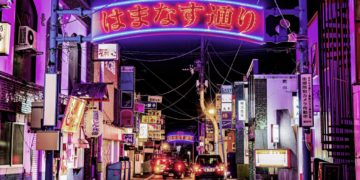








It was a Thursday night in Tokyo. A Japanese friend of mine—let’s call him Taku—asked if I wanted to “experience real Tokyo nightlife.” I figured he meant a local bar or maybe karaoke. Instead, we ended up walking down Kuyakusho-dori, a well-lit street in Kabukicho lined with all kinds of nightlife signs—karaoke boxes, host clubs, love hotels, and restaurants that never seem to close.
Unlike the dark alleys you might imagine when thinking of Tokyo’s red-light district, this street was buzzing and open. Still, there was a certain tension in the air—men in suits promoting clubs, foreign tourists walking by in confusion, and host boys standing confidently outside their buildings.
We stopped in front of a narrow building with a sleek, glossy black entrance. A large illuminated sign listed several venues, each occupying a different floor. One caught my eye—a cabakura (キャバクラ – Japanese hostess club) located in the basement.
“We’re going down there,” Taku said with a grin.
The entrance didn’t look shady at all—in fact, it was spotless and almost too polished. But I still felt a wave of hesitation as we stepped through the glass doors and descended the narrow staircase to B1. At the bottom, we were greeted by a sharply dressed staff member who bowed slightly, asked if we had a reservation, and then led us through a short hallway into the club.
The moment we entered, the world outside vanished. Inside was another Tokyo—velvet sofas, golden chandeliers, mirrored walls, soft background music, and a group of women in glamorous dresses lined up with practiced smiles.
Welcome to the world of Japanese cabakura—a nightlife culture both refined and ritualistic, familiar to many Japanese men but often completely hidden from tourists.
What I experienced that night was layered: warm hospitality, subtle social games, plenty of alcohol, and a level of performance that blurred the line between conversation and fantasy.
Here’s what you need to know—before you ever decide to walk down those stairs yourself.
🥂 What Are Hostess Clubs?
At their core, hostess clubs are high-end lounges where male customers pay to spend time with female staff called “hostesses.” The job of the hostess is not to serve drinks (that’s what bartenders are for), but to talk, flatter, laugh, pour drinks, and make you feel important.
This is not a brothel. There is no sex. There is no physical contact. It’s all about companionship and conversation—with a touch of fantasy.
In many ways, it’s like a performance:
-
The hostesses remember your drink.
-
They compliment your fashion or success.
-
They laugh at your jokes (even when they’re bad).
-
They might share personal stories, but you know it’s part of the charm.
Think of it as a live, elegant version of Instagram DMs.
💴 Typical Pricing and Experience
Here’s where things get real: it’s expensive.
⏱ Entry Fee:
-
Around ¥8,000 to ¥15,000 for 60 minutes.
-
This usually includes house drinks and your table fee.
-
Don’t be surprised when the final bill includes 30–40% in service fees and tax.
🍷 Drinks:
-
Your drinks are included (usually house whiskey or shochu).
-
If you want to order drinks for the hostess? Be ready to pay ¥1,500–¥3,000 per drink.
-
Champagne? That can cost over ¥10,000—and they’ll appreciate it. I suppose.
🧾 Final Bill:
-
For a basic night: ¥20,000–¥30,000 per person.
-
For a big night (multiple hostesses, bottles, snacks, long stay): easily over ¥50,000.
And no, tipping is not expected—it’s built into the system.
🛂 Foreigner Policy: Can You Enter?
✅ The honest answer: It depends.
Some hostess clubs in tourist-heavy areas like Roppongi or Kabukicho will allow foreign guests, especially if you’re with a Japanese person. Others—especially higher-end places in Ginza or Akasaka—may refuse entry to foreigners, even politely.
Why? A few reasons:
-
Language barrier: Hostesses may not speak English well.
-
Cultural mismatch: Many clubs worry that foreigners won’t understand the unspoken rules.
-
Reputation management: They don’t want loud or inappropriate behavior that could disturb regular clients.
👉 Your best shot:
Go with a Japanese friend, or ask a hotel concierge to arrange a reputable place (some luxury hotels can do this).
🤔 Are They Worth Trying?
So… is it a cultural experience? Or a waste of money?
🎎 As a Cultural Window:
-
Absolutely.
You’ll see a side of Japanese nightlife that’s usually invisible—one that plays with fantasy, status, etiquette, and emotional distance.
-
The rituals are fascinating: bowing, pouring drinks, calling the customer “sir,” using polite speech.
-
It’s a unique setting where power and vulnerability switch constantly. You’re paying to be powerful, but also vulnerable enough to want attention.
💸 As a Night Out:
-
If you’re expecting action, don’t go.
-
If you’re expecting deep conversation, also don’t go.
-
If you’re curious, respectful, and okay with spending some money to observe a fascinating part of Japanese culture—then yes.
💡 Insider Tip:
The first visit is never the best. Hostess clubs rely on regulars. If you come back again, they’ll remember you, give better service, and even send you personalized messages. It’s all about the long game.
😅 My Final Take
I left that Kabukicho hostess club a little confused. I hadn’t flirted. I hadn’t danced. I hadn’t even been asked about myself that much. But I saw something I’d never seen in any bar, club, or lounge anywhere else in the world:
A carefully choreographed space where loneliness, status, and fantasy gently collided—all while drinking overpriced whiskey with a stranger who knew exactly what to say.
Would I go again? Probably not often.
Am I glad I went once? Absolutely.
✅ Summary for First-Timers:
|
Question |
Answer |
|---|---|
|
Is it legal? |
Yes, fully licensed and regulated. (most of the places…) |
|
Is it sexual? |
No, it’s conversational fantasy. |
|
Can women go? |
Some clubs allow it, but it’s not common. |
|
Is it worth it? |
If you’re curious and respectful, yes—for the experience. |
|
Should I go alone? |
No—go with a local if possible. |